The engendering of uncertain data in ordinary access news sources, for example, news sites, web-based life channels, and online papers, have made it trying to recognize capable news sources, along these lines expanding the requirement for computational instruments ready to give into the unwavering quality of online substance. For instance, counterfeit news outlets were observed to be bound to utilize language that is abstract and enthusiastic. At the point when specialists are chipping away at building up an AI-based apparatus for identifying counterfeit news, there wasn't sufficient information to prepare their calculations; they did the main balanced thing. In this chapter, two novel datasets for the undertaking of phony news locations, covering distinctive news areas, distinguishing proof of phony substance in online news has been considered. N-gram model will distinguish phony substance consequently with an emphasis on phony audits and phony news. This was pursued by a lot of learning analyses to fabricate precise phony news identifiers and showed correctness of up to 80%.
TopExistingsystem
Deep learning is progressively being recognized as an essential tool for artificial intelligence research in many suitable applications of different areas. Deep learning models are mostly used in image recognition and speech recognition (Ahamed et al, 2016). However, the research community applied deep learning algorithms to find out the solutions for different problems in varied alternative fields (Ahamed et al, 2018). A deep learning algorithm is approximately classified into four types: 1.Q-learning, 2.Recurrent Neural Network (RNN), 3.Convolution Neural Network (CNN) and 4.Deep Neural Network (DNN). These functionalities quickly evolve with many packages together such as; Theano, Tensorflow, CNN, Caffee, and Keras, etc. The objective of traffic flow prediction is to give such traffic flow information in a visualized manner. The design of DNN is used to estimate the traffic conditions, exploitation time period, and transportation from a large amount of data. The recommended DNN model aims to differentiate the non-congested conditions through the provision of multivariate analysis. The stacked auto-encoder is employed to find out the general traffic flow options with a trained layer that works in a greedy manner. The authors of (Ahamed et al, 2018; Choi et al, 2014) have proposed most effective stacked auto-encoder method, which is applied in order to predict traffic flow features. In this, the feature functionality has been calculated based on the spatial and chronological connection square measure instinctively. The preliminary issues proposed by Poincare and Hilbert analyses that, deep learning permits the nonlinear functions for efficient modelling (Hornet et al, 2017; Lemann eta l, 2017) The Kolmogorov Arnold illustration theorem gives the hypothetical motivation for deep learning analysis (Mukherjee et al, 2013). According to this, any continuous operate of n variables outlined by F(y) is shown in the below manner.
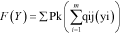
Where pk and qij are the ceaseless capacities and qij is an aggregate premise that does not rely upon F. This outcome infers that any nonstop capacity can delineate the abuse tasks of summation and execution sythesis. In a neural system, work on n factors can be spoken to with 2n+1 actuation units and one shrouded layer (Conroy et al, 2015; Ott et al, 2011). In the course of recent years, profound learning has pulled in an a significant number of analysts to formalize the applications. For street data, the traffic stream example is prepared so as to remove intentional data by abusing multilayered structure through a profound algorithmic program (Ott et al, 2011). So as to perform relatedactivities and produce various examples inside the traffic stream, a model named misuse stacked auto-encoder has bee